Ways of Knowing the Outer Hebrides

By Emily Garrow
As part of my summer placement with the University of St Andrews’ Shared Island Stories project, I went to the Outer Hebrides for eleven days to learn about how heritage is engaged with there. I travelled through Lewis, Harris, Benbecula, and North and South Uist with a fellow Museum & Heritage Studies MLitt student for a brief overview of each island’s distinct or shared heritage. I went with the intention of looking into the practices and social activities which are associated with peat; however, throughout my time on the islands it naturally made me think about how people engaged with the land overall.
One of the most valuable parts of the experience was interacting with people on the islands. In 2013 and 2017, VisitScotland and Comhairle nan Eilean Siar found that there was a 97% satisfaction rate for visitors to the Outer Hebrides and that it was a destination people frequently return to. The draw to these islands was reflected in the conversations I had; everywhere I went I saw great enthusiasm for the land, the history, and the feeling of community to only mention a few aspects which may be considered part of the heritage. Whether it was people who had lived there all their lives, people who had returned, people who had moved there, or people who were only passing through, there was a common passion for the place they were in.
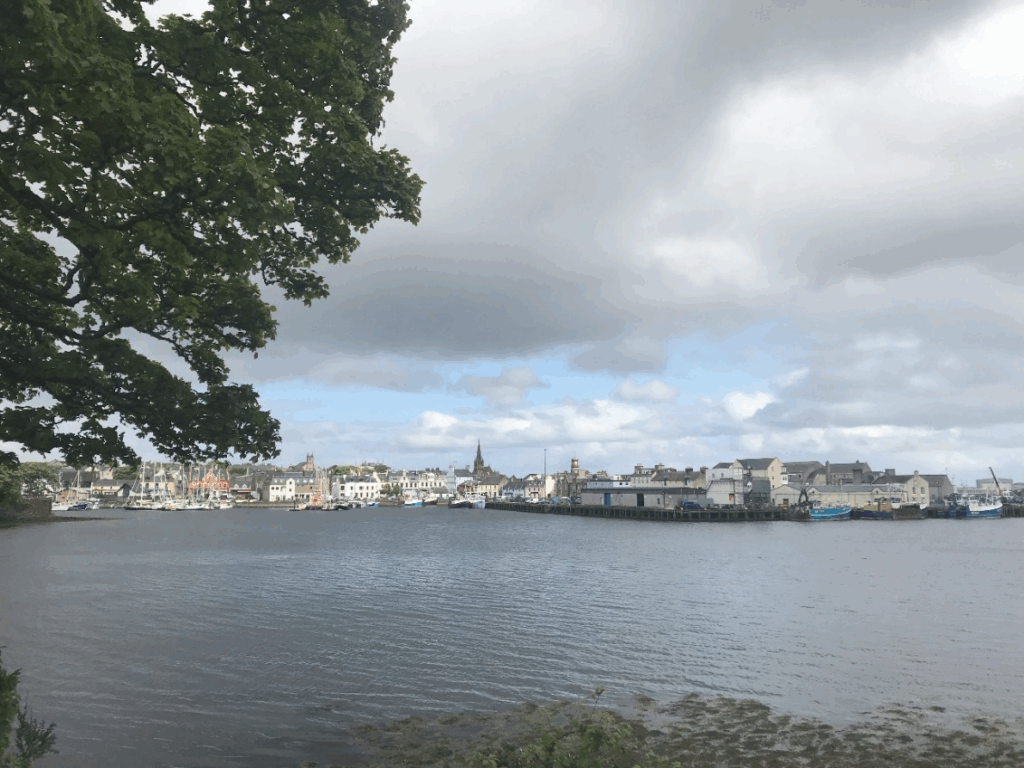
Stornoway from Lews Castle Grounds
These interactions showed how important it is to think about what and who came before us, even if you are only staying somewhere for a short time. The fondness I saw for the Outer Hebrides was intrinsically tied to the land and the activities or craftmenship associated with it. As Jan Assmann and John Czaplicka argue, ‘[t]hrough its cultural heritage a society becomes visible to itself and to others’. While I cannot speak for the people living there, I began to understand that heritage is not something that is in the past: heritage influences what people do and how they feel in the present. I could see that ‘living heritage’ was a fundamental part of how many people interpreted these islands and there was value in passing on this knowledge to others, as outlined by UNESCO. It can make a place special to those who live there and bring in new people.
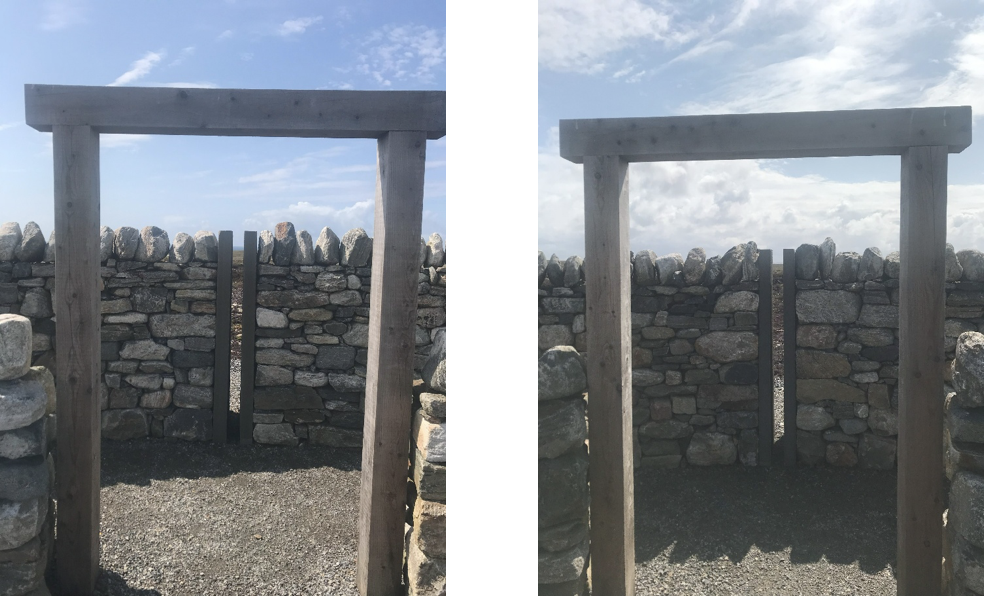
Community land ownership was a topic which regularly came up while I was travelling. I visited Urras Oighreachd Ghabhsainn (Galson Estate Trust) and Urras Taobh Siar Na Hearadh (West Harris Trust) where I heard about the value of communities being in control over their own land. The peat banks behind the UOG building had been used to teach locals how to cut peats with a tairsgeir ‘in a traditional, sustainable manner’. Nearby is the recently constructed monument ‘na Dorsan’ or ‘the doors’ which pays tribute to events from the Galson clearances through to the community buy-out in 2007 and it is said that the shape ‘symbolises unity, offering a sense of safety and belonging’. The monument made me think about how the land is engaged with in the present ─ such as passing on traditional peat cutting practices ─ can happen because of the community’s efforts to maintain them.
Walking around West Harris and admiring the talents of local artists highlighted how formative the land can be for the experiences and, consequently, the heritage there. Peter Davis comments on the way people physically interact with the land creates a ‘local distinctiveness’. I found myself thinking that there may be different attitudes towards the land which brings its own ‘local distinctiveness’ to how it is perceived. While there is no doubt over the beauty of popular tourist destinations such as Luskentyre, seeing the island through the eyes of the people I met along the way helped me understand that other aspects of the land are as, if not more, important. It is associated with memories, history, creative inspiration, livelihoods, and much more. Learning about and engaging with the heritage on these islands may show visitors how vital it is to be respectful of the land and the occupations of the people living there.

Luskentyre Beach
It became apparent that some of the places that I was looking for were not possible for me to identify without directly communicating with locals. It ranged from finding my way to a peat bank, a location in a village, or a place from story; I am still not sure if I was successful in locating the ‘Shieling of One Night’ in Benbecula. Sarah Court and Gamini Wijesuriya advocate for a ‘people-centred approach to heritage’ to support participation, sustainability, and safeguarding knowledge about heritage for the interest of communities and beyond. Court’s and Wijesuryia’s theory may be seen to hold up in practice because people were key for improving my own understanding of the heritage around the land and how it is managed in the Outer Hebrides: it was not something which could reliably be grasped from online sources or otherwise. It is the people and their knowledge which hold the spirit of these islands.

Possibly the ‘Shieling of One Night’
My journey across the Outer Hebrides has made me appreciate the ways that people interact with the land can change the value they attribute to it and influences their understanding of its heritage, even extending to the products that are produced there: to those who gave black pudding recommendations, I refuse to comment on whether Ness or Harris is better. I am grateful to everyone who made my trip such a wonderful experience by taking the time to share their island stories with me.

Bibliography
Assmann, Jan and John Czaplicka. ‘Collective Memory and Cultural Identity’. New German Critique 65 (spring-summer 1995): 125-133.
Court, Sarah and Gamini Wijesuriya. People-Centred Approaches to the Conservation of Cultural Heritage: Living Heritage. ICCROM, 2015. <https://www.iccrom.org/sites/default/files/PCA_Annexe-2.pdf>.
Davis, Peter. ‘Sustaining “Sense of Place” and heritage landscapes’. In International Conference on Community: held at the University of St Andrews 6-8 November 2019, edited by Karen Brown and Azam Caezar. University of St Andrews 2020.
Guthan nan Eilean. ‘The Shieling of the One Night’. TRACS, 2016. <https://tracscotland.org/wp-content/uploads/2016/02/The%20Shieling%20of%20the%20One%20Night_2.pdf>.
UNESCO. Living Heritage and Education. UNESCO, 2019. <https://ich.unesco.org/doc/src/46212-EN.pdf>.
Urras Oighreachd Ghabhsainn, ‘Policy and Procedure No: 19: Peat Cutting/Extraction’, adopted 4 March 2025, 1, <https://www.galsontrust.com/_files/ugd/682f71_cae1986758cb4d51a0193ed8b0d1d232.pdf>.
Urras Oighreachd Ghabhsainn. ‘na Dorsan’. Accessed 11 June 25. <https://www.galsontrust.com/nadorsan>.
VisitOuterHebrides. ‘Insights and Data’. Accessed 11 June 25. <https://www.visitouterhebrides.co.uk/industry/information-resources/tourism-in-the-outer-hebrides/visitor-survey>.
Reflective reports by University of St Andrews MLitt in Museum and Heritage Studies students conducting their summer placements with the Shared Island Stories research project coordinated by ACHS member Professor Karen Brown. Exploring the Outer Hebridean Islands of Scotland, Isabel and Emily have been researching and recording histories and heritage of peatlands and surrounding Intangible Cultural and Natural Heritage.